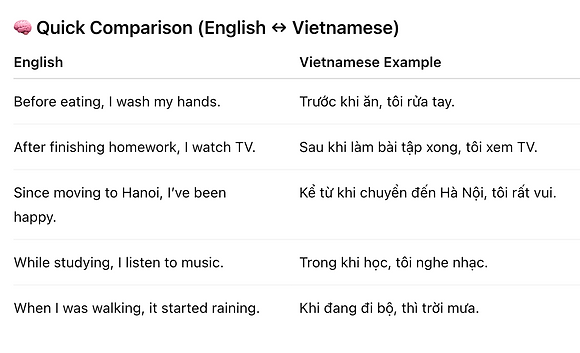
Vietnamese time clause structures:
trước khi / sau khi / kể từ khi / trong khi / khi đang… thì…
🟩 1. trước khi → “before (doing something)”
🔹 Meaning:
Used to describe an action that happens before another action.
🔹 Structure:
Trước khi + Verb / Clause 1, (Subject) + Verb / Clause 2
🔹 English equivalent:
= “Before (doing something), …”
🔹 Examples:
-
Trước khi đi học, tôi ăn sáng.
→ Before going to school, I eat breakfast. -
Trước khi ngủ, tôi thường đọc sách.
→ Before sleeping, I usually read a book. -
Tôi gọi cho bạn trước khi ra khỏi nhà.
→ I called you before leaving home.
🔹 Notes:
-
The verb after “trước khi” can be in infinitive form (no tense marker).
-
It marks the earlier action.
🟦 2. sau khi → “after (doing something)”
🔹 Meaning:
Used to show that one action happens after another action.
🔹 Structure:
Sau khi + Verb / Clause 1, (Subject) + Verb / Clause 2
🔹 English equivalent:
= “After (doing something), …”
🔹 Examples:
-
Sau khi ăn cơm, tôi đi bộ.
→ After eating, I take a walk. -
Sau khi học xong, tôi xem phim.
→ After finishing my studies, I watch a movie. -
Sau khi tan làm, chúng tôi đi uống cà phê.
→ After work, we go for coffee.
🔹 Notes:
-
“sau khi” marks the later action.
-
The first action (after “sau khi”) must be completed before the next begins.
🟨 3. kể từ khi → “since / ever since”
🔹 Meaning:
Used to describe an action or state that started at a specific time in the past and continues until now.
🔹 Structure:
Kể từ khi + Clause / Time phrase, (Subject) + Verb / Clause
🔹 English equivalent:
= “Since (the time when) …”
🔹 Examples:
-
Kể từ khi tôi đến Việt Nam, tôi học tiếng Việt.
→ Since I came to Vietnam, I’ve been learning Vietnamese. -
Kể từ khi anh ấy rời công ty, mọi thứ thay đổi.
→ Since he left the company, everything has changed. -
Kể từ khi kết hôn, cô ấy sống ở Hà Nội.
→ Since getting married, she has lived in Hanoi.
🔹 Notes:
-
Often used with present tense in the main clause to show continuation.
-
Similar to English “since” (not just for time, but also for reason sometimes).
🟧 4. trong khi → “while / during”
🔹 Meaning:
Used when two actions happen at the same time.
🔹 Structure:
Trong khi + Clause 1, (Subject) + Clause 2
🔹 English equivalent:
= “While …, …” or “During …”
🔹 Examples:
-
Trong khi tôi học, em tôi xem TV.
→ While I study, my younger sibling watches TV. -
Trong khi chờ xe buýt, tôi đọc báo.
→ While waiting for the bus, I read the newspaper. -
Trong khi làm việc, anh ấy nghe nhạc.
→ While working, he listens to music.
🔹 Notes:
-
Used when two actions overlap in time.
-
The subjects in the two clauses can be the same or different.
-
Often interchangeable with “khi đang”.
🟪 5. khi đang… thì… → “when … was … / while … was … then …”
🔹 Meaning:
Used when one action was happening, and then another action happened (interruption or simultaneous action).
🔹 Structure:
Khi đang + Verb / Clause 1, thì + Clause 2
🔹 English equivalent:
= “When (someone) was doing something, (then) …”
= “While (someone) was doing …, …”
🔹 Examples:
-
Khi đang ăn cơm, thì điện thoại reo.
→ When I was eating, the phone rang. -
Khi đang đi học, thì trời mưa.
→ While I was going to school, it started to rain. -
Khi đang ngủ, thì có người gõ cửa.
→ While I was sleeping, someone knocked on the door.
🔹 Notes:
-
“đang” indicates a continuous or ongoing action.
-
“thì” marks the main event that happens during or interrupts the first action.
-
If no interruption occurs, you can simply say “trong khi”.